|
|
Places in Spain - The history of Alcudia in Mallorca
|
|
|
The first archaeological remains which have been discovered in Alcúdia appear to be pre-Bronze Age ( 2000 to 1200 BC. ) Numerous talaiots, or monolithic structures, for which talaiotic culture ( 1200 to 123 BC ) is named , can still be found in the municipality, among which the Son Sim- talaiots are the most noteworthy.
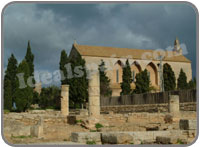
The Roman consul Quintus Cecilius Metellus annexed Majorca to the Roman Republic in the year 123 BC and founded the cities of Pol.lèntia and Palma. Archaeological remains of the city of Pollèntia, siutaded next to Alcúdia, point to an economic prosperity which stimulated the growth of these cities, e.g. stately houses, a theatre, shops and other public and private buildings. |
| |
|
|
The invasions of the Vandals in the 5th century AD plunged Pollèntia into a process of decadence and destruction. Evidence drawn from archaeological excavations show that the Vandals ransacked the city between AD 425 and AD 455. |
| |
In 902, the Arabs conquered Majorca and annexed it to the Cordova Emirate and in 1015 it became part of the Taifa or petty state of Dénia. During Muslim rule ( 902-1229 ) Alcúdia was a farmstead situated between the bay of Pollença and the bay of Alcúdia. The name "Alcúdia"
(el Pujol Hill ) and a few other place names Ginyent, Biniatria, Gatamoix or Alcanada, are all that is left of Arab rule.
After Majorca was annexed to the Crown of Aragon in 1229, King James I divided the island into eight parts; four stayed in his own hands and the remaining four went to nobles who had fought by his side in the conquest of the island. Most of Pollença and Alcúdia was split between the Templars, Sir Guillem de Montcada and Sir Vicent de Portugal. It is believed that a small group of people first established themselves as a community in the area of Guinyent at this time, although it is possible that this community had already existed before Conquest. |
| |
|
At a later date, James II ordered the construction of a village on the site of an old Muslim farmstead and in 1298 elevated it to the status of the municipality. To that purpose, he purchased a house and acquired land on which to build the old "quartera" and a square, parish church, rectory and cemetery. The village took Saint James as its patron.
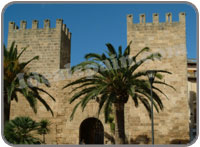
Construction of a ring of walls designed to protect not only the village, but also the entire northern section of the island was begun in 1298 and completed in 1362. |
|
|
| |
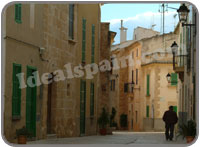
| The medieval layout of the city of Alcúdia was limited and contained by the walls which surrounded it. On its winding and narrow streets, buildings of great architectural interest still stand which preserve characteristic elements of that splendid style of constructions: arches, Renaissance windows, entrance halls with semicircular arches, Gothic staircases. |
|
|
|
The village's walled enclosure served as refuge on a number of occasions , but it was during the popular 16th century popular revolt called "les Germanies" when Alcúdia proved to be crucially important. Majorcan nobility sought refuge inside its walls until the troops of Emperor Charles V put the rebellion down. Afterwards, the village's loyalty was repaid and it was elevated to the rank of "Faithful City" in 1523 which afforded other privileges.
The years after the Germanies rebellion were difficult ones for Majorca in general, Alcúdia included. Its coastal position, previously advantageous, became the cause of its ruin: the much-feared pirates arrived by sea and sacked the population over and over again, an example of which was the pillaging of Cap de Pinar in 1558.
Insecurity in the region and the flight of property owners to the city caused the population of Alcúdia to decline to such a extent that , in 1779 during Charles III's reign , an effort was made to rehabilitate the harbour for commercial use to stimulate economic activity and repopulate the city. |
|
|
|
Tourists first began to visit Alcúdia at the beginning of the twentieth century, but as with the rest of Majorca, it was the 1970's that brought the big tourist boom. The great marshlands of the Albufera were drained and large hotel complexes built there. The 80's witnessed a new construction boom. At present, Alcúdia's economy is entirely devoted to the tourist trade and potential occupancy of more than 29,000 beds.
The commercial harbour of Alcúdia specialises in the production of electrical energy supplying both Majorca and Menorca. There is also a considerable volume of goods which arrive in Majorca via this harbour.
At present, the city of Alcúdia has more than 10,000 inhabitants and as a result of the important economic activity it generates ranks only after Palma as the second most active urban centre.
Alcúdia-Town and the archaeological zone of Pollèntia was monument listed by decree 21/41 on the 20th July 1963. Recently several projects have been carried out in order to conserve and protect the area. |
|
|
| |
|
|
|