|
Seville
is one
of the
most
beautiful
cities
that
we
have
visited
in the
whole
of
Spain.
We
managed
to see
most
of it
in two
days.
The
city
was
quite
easy
to
navigate
and
driving
around
was
unusually
calm.
The
best
place
to
base
yourself
is in
the
old
quarter,
near
the
cathedral,
as we
did.
From
here
you
can
walk
to
most
sights.
Here
we
have
outlined
just a
few of
them. |
 |
|
 |
|
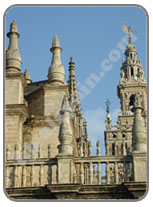
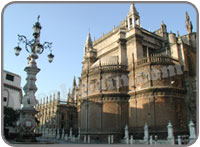
The
most
impressive
building
in the
city
has to
be the
biggest
gothic
Cathedral
in the
world,
building
began
in
1401.
In
total
the
cathedral
houses
over
500
works
of
art,
some
of
which
are
the
most
important
in the
world.
See
picture,
right
and
above.
The
tallest
tower
in
Spain
stands
in
Seville,
attached
to the
cathedral,
La
Giralda
(Moorish
Tower),
319
feet
high,
a
symbol
of the
city's
importance.
The
tower
is an
ancient
minaret
of the
Islamic
Mosque
and
was
erected
in
1184.
its
foundations
utilise
stones
from
Roman
monuments.
|
|
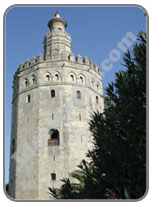
The
Torre
del
Oro
or
Golden
Tower
(pic
below)
was
built
between
1221
and
1222
and
was
one of
the
last
contributions
from
the
Almohade
period
in
Seville.
It
formed
part
of the
last
wall
of
defence
that
ran
from
the
Alcazar
to the
river.
It is
said
that
it
gained
its
name
from
the
sun's
reflection
on its
gold
tiles
that
once
covered
the
dome.
Today
it
houses
the
Naval
Museum
and
all
the
gold
has
sadly
been
stolen.
You
will
find
it
alongside
the
river,
close
to the
bullring.
|
 |
 |
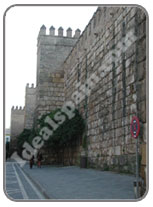
The
Alcazar
is a
collection
of
Moorish
Palaces
on
which
building
began
in
931.
It has
over
the
years
been
the
residence
of
many
monarchs.
The
buildings
and
gardens
are
enclosed
by
walls
and
lined
with
orange
trees.
The
entrance
into
the
Patio
de
Banderas
is
pictured
above. |
|
|
|
The
Casa
de
Pilatos
(House
of
Pilate),
was
built
at the
end of
the
15th
century
and
was
later
extended.
The
archaeological
gardens
house
some
interesting
statues
and
marble
works.
The
Monasterio
de la
Cartuja
dates
back
to the
14th
century.
The
site
was
ransacked
during
the
French
invasion
and
the
monks
were
expelled
in
1835.
Shortly
afterwards
it
became
a
ceramics
factory. |
 |
|
|
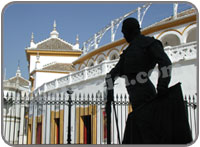 |
The
Plaza
de
Toros
(bullring)
is an
18th
century
construction
that
initially
was
built
of
wood.
In
1761
its
enclosure
in
stonework
began.
After
delays
caused
by the
Spanish
Civil
War,
it was
completed
in
1881.
The
museum
in the
bullring
offers
an
insight
into
the
history
of
bullfighting.
The
beginning
of the
bullfight
season
takes
place
on
Easter
Sunday
and
finishes
in
September. |
|
|
|
La
Calle
Feria
(Feria
Street)
is one
of the
longest
streets
of the
city
and
has
always
been
noted
for
its
history
and
its
charm.
he
street
is
lined
with
shops
and
workshops
and
runs
from
Resolana
Street
to San
Juan
de
Palma
Square.
Every
Thursday
the
street
is the
scene
of a
traditional
market
where
stalls
feature
everything
from
paintings
to
antiques
and
furniture.
The
public
market
is
also
located
on
this
street
and is
worthy
of a
visit.
Some
of the
important
buildings
on the
street
include
a
Gothic
church
and
the
remains
of a
palace.
Feria
Street
is a
good
place
to
start
your
tour
of the
city
if you
are
short
of
time. |
|
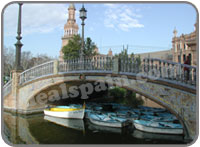
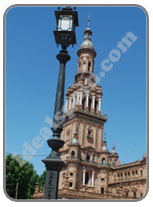
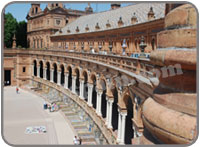
The
Plaza
de
España
(see
photo
right)
is a
´must
see`
with
it's
beautiful
fountain,
surrounded
by a
large
plaza
and an
artificial
river.
Around
the
plaza
stands
a
monument
that
forms
a vast
semi-circle
of
200m
diameter,
with a
tower
at
each
end.
Along
the
front
are
benches,
covered
in
colourful
tiles,
each
one
dedicated
to a
province
of
Spain.
They
are
placed
in
alphabetical
order.
Each
province
is
separated
by
small
cupboards
designed
to
house
a
basic
library
on
each
province.
Inside
the
building
you
can
visit
the
spectacular
patio
with
it's
two
floors,
arches
and
columns. |
 |
|
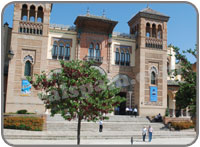
Near
to the
plaza
is one
of the
city's
most
beautiful
places,
the
Parque
de
Maria
Luisa.
The
park
covers
some
400,000
square
metres
of
woodland,
water
features
and
squares.
When
visiting
Seville,
you
should
spend
at
least
a
couple
of
hours
here.
Within
the
park
you
will
also
find
the
two
most
important
museums
in the
city.
(see
photo
of
Museum
of
folk
art
and
customs
below) |
 |
Seville
also
has a
wealth
of
culture
to
offer
the
visitor
and
the
city
boasts
several
important
theatres.
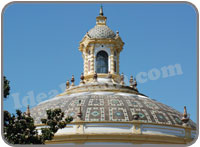
Pictured
below
is the
Cupola
of the
Casino
that
is
joined
to the
Lope
de
Vega
Theatre.
The
dome
was
built
for
the
1929
exhibition
in the
city. |
|
Museums
in
Seville
also
include
the
Carriage
Museum,
housing
a
unique
and
very
important
collection
of
historical
transport
and
the
Archaeological
Museum
which
is
housed
in a
palace
and
has 27
rooms
containing
artefacts
from
Iberic,
Phoenician,
Carthaginian
and
Roman
villages
around
Seville.
|
 |
|
|
|
For
the
Expo
'92,
Seville
underwent
massive
changes,
opening
her
doors
to the
world.
The
new
Golden
Gate
Bridge
became
a
wonderful
attraction
and an
Expo
complex
of
huge
proportions
was
constructed
on the
south
side
of the
Rio
Guadalquivir.
It is
here
that
you
will
find
the
huge
discoveries
park,
the
Olympic
stadium
and
the
theme
park.
You
will
also
see a
little
of the
old
city
walls,
still
intact.
Seville
has
its
own
airport
and
well
serviced
train
and
bus
stations
and is
therefore
easy
to get
to. If
you
get
chance,
why
not
take a
trip
along
the
river
on one
of the
several
tourist
boats
or
take a
tour
round
the
city
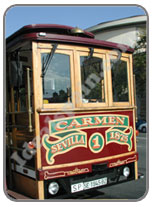
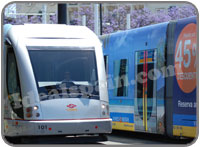
on the
open
top
bus or
public
tram.
You
can
obtain
details
of
these
and
many
other
things
from
one of
the
tourist
offices.
The
easiest
to
find
is the
one on
Avenida
de la
Constitucion,
500
metres
from
the
cathedral. |
|
|
 |
Fiestas
and
Traditions
Massive
events
in
Easter
Week (Semana
Santa)
in
March/April.
April
Fair
(Feria
de
Abril)
and
Rocio
Monday
in
May/June.
There
are
many
places
in
Seville
to see
Flamenco
shows
which
are
very
popular.
Contact
the
tourist
office
for
details.
|
|
Climate
Seville's
weather
may be
labelled
as
warm-hot.
Long,
dry
and
hot
summers
and
warm
winters.
Annual
average
temperature
is
18.2oC,
raising
to
26.6o
in
July
and
August,
although
it can
reach
40-42o.
It
rarely
falls
below
2-3o
even
in the
winter
and
rain
is
scarce. |
|
|
|
Whilst
in the
area
of
Seville,
you
may
wish
to
visit
the
Roman
city
of
Italica.
The
massive
complex
of
Roman
ruins
is one
of the
most
important
in
Spain
and is
located
about
20
minutes
north
of the
city.
Follow
the
signs
in the
direction
of
Merida,
to the
little
village
of
Santiponce.
See a
report
of our
visit
here. |
 |
|
|
| |
| |